How to design a dinner party menu (and why a printed one changes the night)
A practical guide to planning, writing, and printing a dinner party menu — for home hosts and private chefs. Course structure, descriptions that guests read aloud, a timeline that prevents the day-of panic, and why a printed menu at every setting is the detail that turns a Saturday into a tasting.
Carte AI Editorial
The food is the obvious part of a dinner party. The menu — the actual designed, written, printed object — is the part hosts often forget. Most home cooks don't make one. Most private chefs make one and don't make it well. But the menu is the first thing your guests see when they sit down, and the small detail that tells them, without saying it, that you thought about them.
Here is how to design a dinner party menu — whether you're hosting friends on a Saturday or planning a tasting for a discerning client.
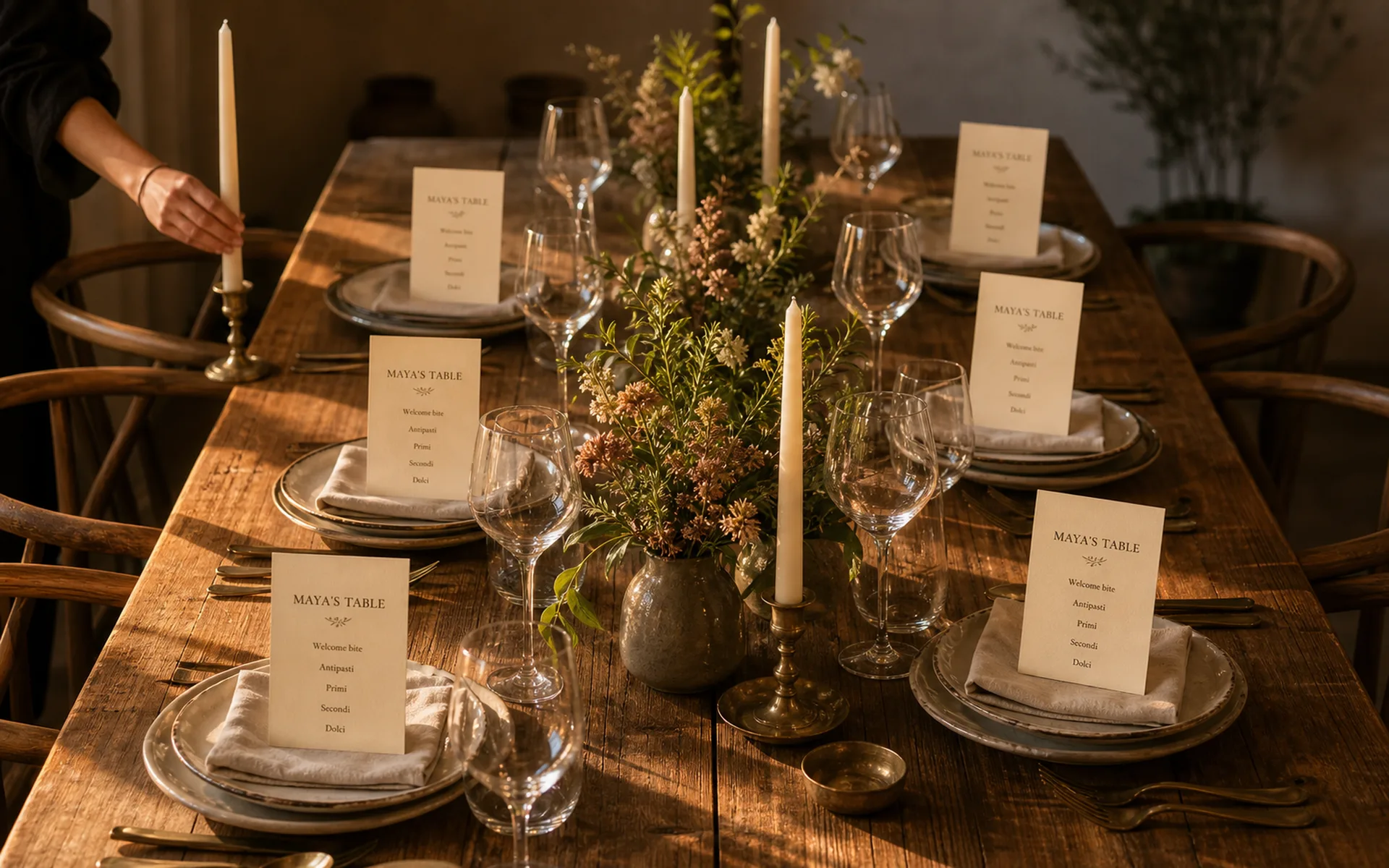
Start with the room and the guests, not the dishes#
The temptation when planning a dinner is to start with the food. Resist it.
Start with the room. Is it a small kitchen island where everyone clusters in? A long dining table extended with leaves? A garden patio with mismatched chairs? The room's character shapes the menu's tone. A long formal table wants a tasting; a kitchen island wants family-style platters.
Then ask: who's coming? Not their faces — their context. Is this a 40th birthday where the host wants to impress, or an old-friends reunion? Are there guests who haven't met yet, or a group already deep in conversation by the second sip? Are there allergens or dietary lines to respect? The guests determine the menu's voice — confident and ceremonial for a milestone, warm and conversational for an annual ritual.
The food comes third. After you know the room and the guests, the dishes almost design themselves.
Pick a course structure that fits the night#
There are three common patterns. Pick one before you pick any dish.
- A 3-course classic. Starter, main, dessert. Honest, comfortable, easy to time. Best for a relaxed Saturday with friends, where the conversation matters more than the procession.
- A 5-course progression. Welcome bite, appetizer, main, cheese or salad, dessert. Feels deliberate. Signals an occasion. The pacing — the pauses between courses — is the host's gift. Best for milestones, anniversaries, or a private chef's tasting for a client.
- Family-style platters. Everything on the table at once. Less ceremony, more abundance. Best for warm, conversational dinners — the Italian Sunday-supper feel.
Pick the structure first, then fill it. A 5-course tasting where you didn't plan the welcome bite ends up feeling cold. A family-style dinner that you split into courses ends up feeling fussy. The structure is the bones; you're designing for the bones.
Build the menu from your strengths#
The biggest mistake home cooks make: choosing dishes they've never cooked before for an important dinner. The biggest mistake private chefs make: showing off rather than serving the room.
Build the menu around dishes you know cold — the ones you can plate in your sleep — and only stretch on one course. The dessert, maybe, or a centerpiece main. Everything else is something you've made before and you know lands.
This matters more than it sounds. A dinner where everything is technically ambitious but the host is exhausted by course three reads as anxious. A dinner where most of the food is familiar and one element is a quiet surprise reads as generous. Pick your stretch carefully.
Write descriptions guests will read aloud#
Once the dishes are set, write the descriptions. Not the recipe — the description. The thing a guest reads on the menu before the dish arrives, that primes them to taste it.
Bad: "Pan-seared salmon with seasonal vegetables and lemon butter."
Better: "Salmon, brown butter, the first asparagus of the season."
The first version reads like a chain restaurant. The second reads like a person. The trick is to write what's in the dish (so guests' preferences and allergens are honored) without the over-explanation. Three to seven words per description is usually right. Anything longer starts to feel like a tasting menu at a restaurant trying too hard.
If you're using an AI menu generator like Carte, the descriptions tend to skew long out of the box — ask the agent to "tighten this to one short sentence" in the chat and it will. The same dish reads more confident in fewer words.
The detail most hosts skip: the printed menu#
This is where most home dinners fall short of professional ones — and where the difference is almost free to close.
A printed menu at every place setting is the small thing that turns a Saturday into a tasting menu. It does three things at once:
- It signals intention. The guest sees, before they've eaten a bite, that you planned this.
- It gives the dinner structure. People know what's coming, which makes the pauses between courses feel deliberate rather than nervous.
- It becomes a takeaway. The guest leaves with a small printed card — "For Sarah's 40th, 14 June 2026" — that becomes a small memory.
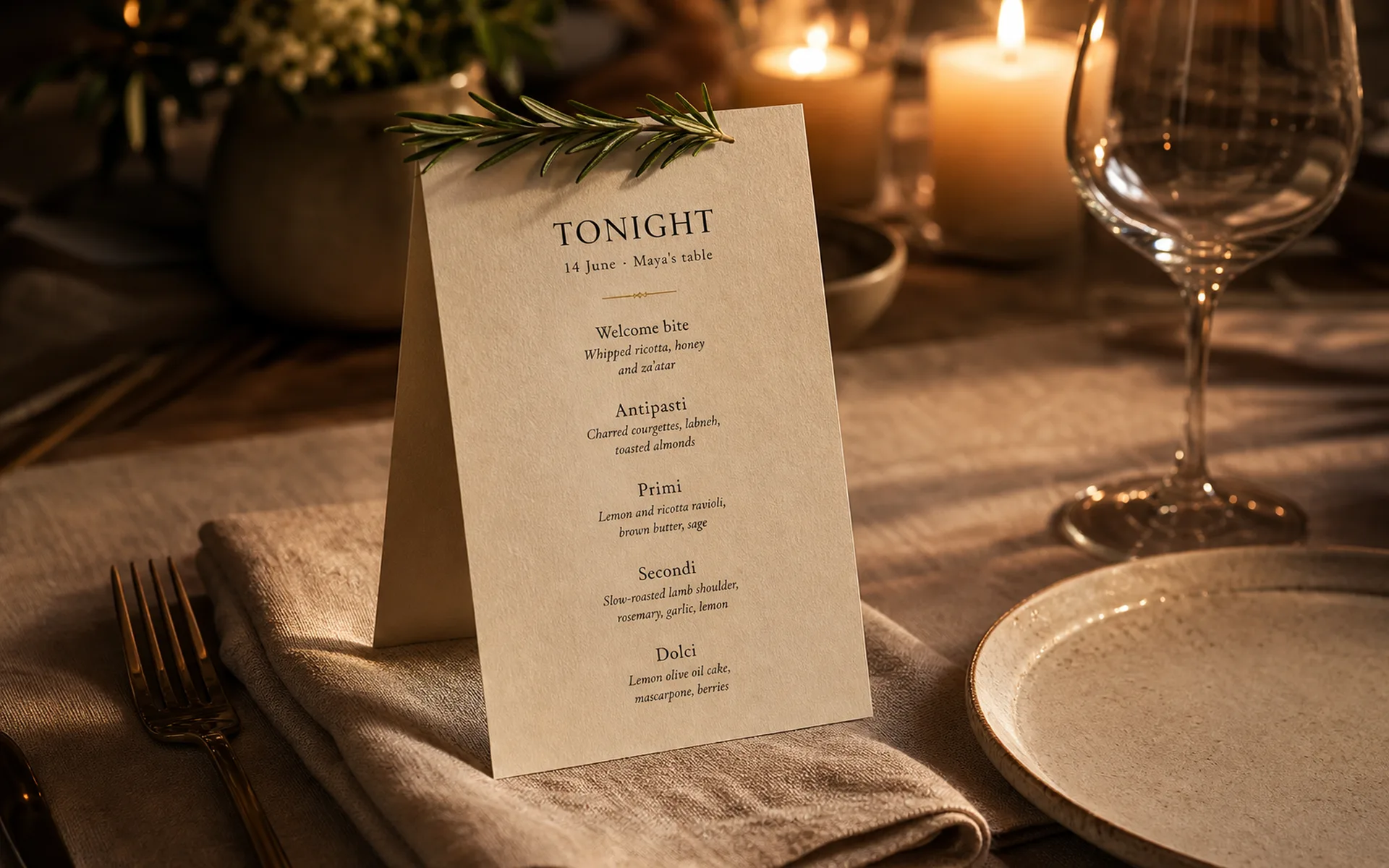
You don't need a print shop. A home printer on cream cardstock is enough. Fold each menu so it stands on its own at the plate. The first thing guests do when they sit down is read it aloud to each other, often joking about which course they're most looking forward to. That moment — the menu being read at the table — is the start of the dinner, and it's the part most hosts never get because they never print one.
For private chefs working in clients' homes, this is also where you separate yourself from anyone else who can cook. Your client could hire any chef. The one who shows up with a designed, printed menu — with the client's name on the masthead, with the date — is the one who gets called back.
A planning timeline that actually works#
Hosts often underestimate how much non-cooking work goes into a dinner. A rough timeline that prevents the day-of panic:
- A week before: decide the menu. Lock the dishes. Send any pre-shop list.
- Three days before: write the descriptions. If you're using an AI menu designer, this is when you generate the first draft and refine.
- Two days before: prep what you can — stocks, sauces, doughs, marinades. Anything that gets better with time in the fridge.
- One day before: clean and set the room. Lay the table. Print the menus. Chill the wine.
- Morning of: finish the prep. Run a mental dress rehearsal of the timing.
- One hour before guests arrive: stop cooking ambitious things. Put the menus at each setting. Light the candles. Pour yourself a small glass of something.
The menu is on the table before the guests arrive. They should walk in to a room that's ready, not a host who's still wiping down the counter.
From a single dinner to a small portfolio#
For private chefs, every dinner you cook is also a working portfolio. A client who's about to hire you wants to know what kind of evenings you create — not just what you cook.
A small library of designed menus from past clients does this better than a paragraph on a website. Maya's Table, 14 June. Hudson Valley Dinner, September 2025. An Evening with the Chens. When a new prospective client opens a link and sees ten dinners you've already designed, the question moves from "can you cook?" to "when can we book you?"
For home hosts, the same archive becomes something different — a memory book of the years you've fed people. Most dinner parties disappear into camera-roll photos. The printed menus, archived together, are the part that lasts.
When the menu becomes part of the night#
The dinner is the food. But the night — the whole hosted moment — is bigger than what's on the plates. The menu is one small piece of how you express that: the printed card at each setting, the voice chosen for the descriptions, the date on the masthead, the dishes named with care.
Make it for the guests. Make it for yourself. Print one at every plate. The night feels different when you do.
Ready to design your next dinner menu? Carte gives you an AI design partner who learns what you serve and writes in your voice. Brief it once, refine in chat, print one at every setting, archive it forever. For more on hosting menus specifically, see our dinner parties and private chefs guide.